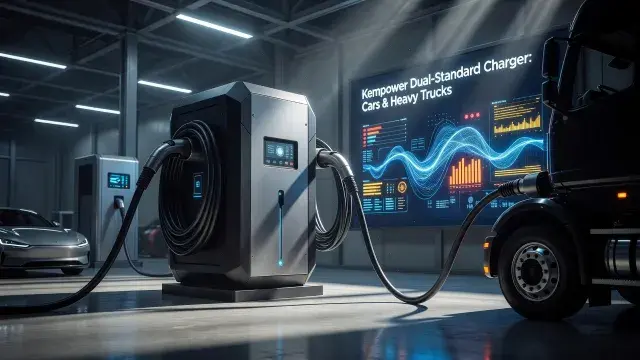
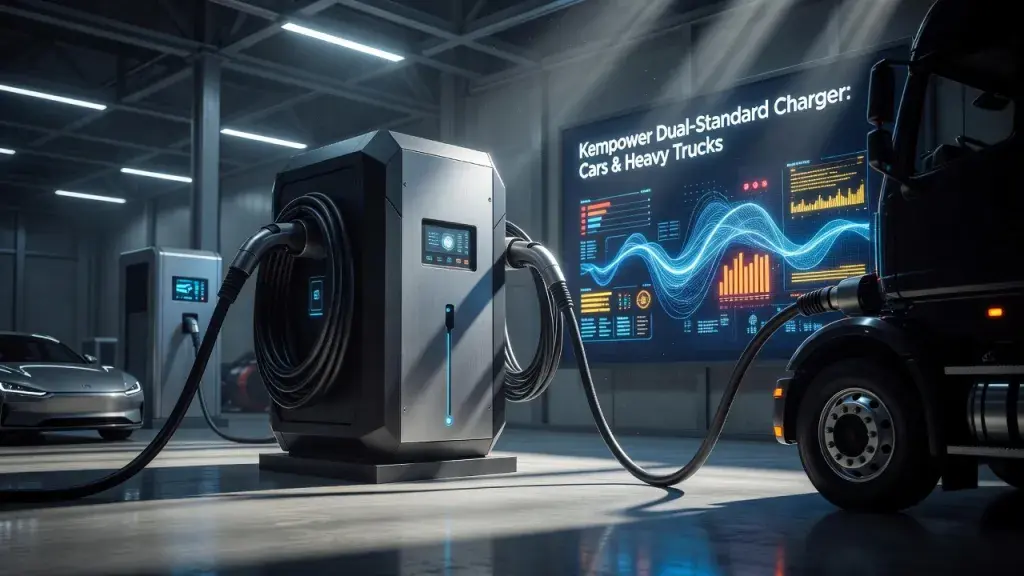
Kempower has introduced a charging unit designed to close one of the more expensive gaps in electric vehicle infrastructure: the divide between passenger car charging and the higher-power systems heavy trucks require. The new Mega Satellite Flex supports both the established Combined Charging System, delivering up to 560 kW, and the emerging Megawatt Charging System, capable of up to 1.2 MW. It marks the first time the Finnish manufacturer has combined both standards in a single dispenser.
The timing reflects where the industry actually stands right now, not where it eventually hopes to be. CCS remains the dominant standard for electric cars across North America and Europe, while MCS is only beginning to appear at depots and corridor sites built for electric trucks that need to recharge large battery packs in short windows. Operators planning new charging sites have had to guess which standard to prioritize, or build for both at considerable extra cost. Kempower's answer is a single piece of hardware that serves either vehicle type from day one, a detail fleet planners and infrastructure investors researching options - perhaps after they download the app to compare charging networks - will want to note as they map out where to deploy capital. download the app
Why One Dispenser for Two Standards Matters
Charging infrastructure economics depend heavily on utilization. A dispenser that sits idle waiting for the right vehicle type to show up is a poor use of expensive grid capacity and real estate. By supporting CCS and MCS from the same unit, Kempower is betting that operators will get more consistent use out of each installation, since the same physical space can serve a passenger car in one session and a heavy truck in the next. That flexibility becomes more relevant as trucking fleets electrify unevenly across regions and timelines, leaving many sites serving a mixed stream of vehicles for years to come.
The technical specifications reinforce that dual purpose. The unit supports up to 1,500 amps for MCS sessions and 700 amps for CCS, with cable lengths tailored to each: 5 meters for CCS and a shorter 2.7 meters for MCS, reflecting the more direct connection typical of truck charging bays. An optional payment terminal allows the same hardware to serve public, pay-per-use charging as well as fleet depots running on account-based billing.
Built for the 800-Volt Shift
The Mega Satellite Flex also accommodates 800-volt electrical architectures, an increasingly common design in newer EVs precisely because it allows faster charging without pushing current to extreme levels. As more manufacturers move toward 800-volt platforms, chargers that cannot take advantage of the higher voltage become a bottleneck rather than a convenience. Supporting this architecture now, rather than retrofitting later, is part of what Kempower frames as a strategy to protect the useful life of a charging installation as vehicle technology continues shifting.
Fitting Into Existing Networks
Because the new unit works with Kempower's existing distributed charging architecture, operators who already run Kempower systems can add the Mega Satellite Flex without redesigning their power distribution or software integration. That compatibility matters for site owners weighing incremental upgrades against full rebuilds, particularly at locations where trenching new power runs or upgrading transformers would add significant cost and delay.
Kempower unveiled the charger at its Unplug & Recharge event held alongside ACT Expo, where it remains on display this week. The company expects the Mega Satellite Flex to reach the North American and European markets in July 2026, giving fleet operators and charging network developers over a year to factor the unit into site planning as megawatt charging infrastructure continues its gradual rollout alongside the more established CCS network.