
Every unencrypted connection to a pornographic website leaves a visible trail - readable by your internet service provider, logged by the site itself, and potentially exposed to advertisers, data brokers, or government agencies. Privacy on the open internet is not a default state; it is something you must actively construct. For anyone concerned about who sees their browsing activity, a Virtual Private Network is the most effective starting point available to ordinary users today.
Why Your ISP Sees More Than You Think
Internet service providers occupy a privileged position in the data chain. Because all traffic passes through their infrastructure, they can observe which domains you visit, when you visit them, and for how long - unless that traffic is encrypted end-to-end before it leaves your device. Most consumer broadband connections do not provide this protection by default.
When you visit an adult site without a VPN, your ISP receives a clear record of that request. Depending on your country's data retention laws, that record may be stored for months or years. In several jurisdictions, ISPs are legally required to retain metadata and make it available to authorities upon request. Even where no such law exists, commercial data sharing between ISPs and third-party analytics firms is a documented and ongoing practice.
A VPN disrupts this by creating an encrypted tunnel between your device and a remote server operated by the VPN provider. Traffic leaving your device is scrambled using strong encryption - currently the industry standard is AES-256, the same cipher used to protect classified government communications. From your ISP's vantage point, the connection appears as an opaque stream of data directed at the VPN server's IP address. The destination, the content, and the nature of the session are entirely hidden.
What a VPN Actually Does - and What It Does Not
Understanding the mechanism matters, because VPNs are frequently oversold and misunderstood. Here is what a well-configured VPN with a strict no-logs policy genuinely provides:
- IP address substitution: The adult site you visit sees the VPN server's IP address, not yours. This severs the direct link between your identity and your browsing session.
- Traffic encryption: Data in transit between your device and the VPN server cannot be read by your ISP, network administrators, or anyone monitoring the connection.
- No activity logs: Reputable providers operate on RAM-only server infrastructure, meaning session data is never written to disk and cannot be handed over to third parties even under legal pressure.
- Geo-restriction bypass: In states and countries where specific adult platforms have been blocked - following age-verification legislation in Texas, Louisiana, and elsewhere - a VPN allows access by routing traffic through a server in an unaffected jurisdiction.
What a VPN does not do on its own: it does not block malware embedded in ads and pop-ups, it does not prevent adult sites from setting cookies if you allow them, and it does not make you anonymous if you voluntarily create an account tied to your real email address or payment information. Anonymity is a practice, not just a product. The VPN is the most important layer, but it is one layer among several.
Some providers, including NordVPN, have extended their offerings to include threat protection features - blocking known malicious domains, filtering tracker scripts, and intercepting malware-laden ads before they reach your browser. Adult websites are a well-documented vector for malware distribution, particularly through third-party advertising networks that operate with less scrutiny than mainstream ad platforms. A VPN that bundles this kind of protective filtering addresses a real and underappreciated risk.
Incognito Mode, Proxies, and Other Partial Solutions
Browser incognito mode is useful in one narrow context: it prevents your local browsing history from being saved on the device. That is the full extent of its privacy protection. It does nothing to conceal your traffic from your ISP, nothing to mask your IP address from the sites you visit, and nothing to block tracking scripts. Using incognito mode without a VPN is the digital equivalent of closing the blinds while leaving the front door open.
Proxies are similarly limited. A proxy reroutes your traffic through an intermediary server and can change your visible IP address, but it applies no encryption to the connection. Your ISP can still see the nature of your traffic. Many free proxy services also inject their own tracking or advertisements - the opposite of what a privacy-conscious user needs.
The Tor network offers a stronger anonymity model by routing traffic through multiple volunteer-operated relays, each of which knows only the previous and next hop in the chain. However, Tor is significantly slower than a commercial VPN, can trigger security alerts on many websites, and is poorly suited to bandwidth-intensive activities like streaming video. For most users, a no-logs VPN from a reputable provider represents the practical intersection of strong privacy protection and usable performance.
Choosing a Provider: What to Look For Beyond Marketing
The VPN market contains hundreds of providers, and the quality gap between them is substantial. When evaluating a provider for this specific use case, the relevant criteria are narrower than the full checklist a corporate security team might apply.
- Verified no-logs policy: Look for providers that have undergone independent third-party audits of their logging practices. A marketing claim is not a substitute for an audit.
- Jurisdiction: Providers headquartered outside major intelligence-sharing alliances face less legal pressure to comply with data disclosure requests. This matters if you take your privacy seriously.
- Malware and tracker blocking: Given the threat profile of adult websites, built-in ad and malware filtering is a meaningful feature, not a cosmetic extra.
- Speed and server coverage: Streaming video requires consistent throughput. Providers with large server networks in geographically distributed locations tend to perform better under load.
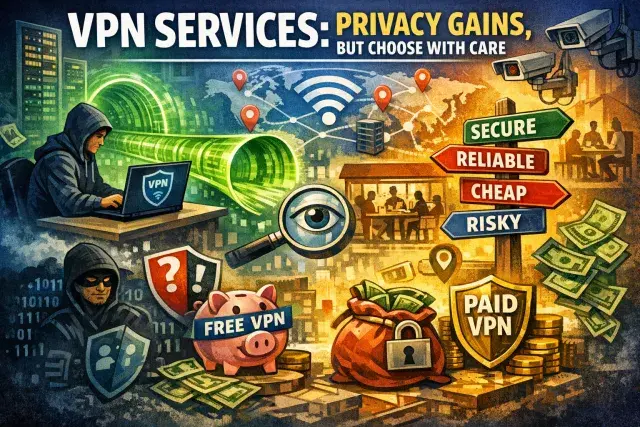
- Free tier risks: Free VPN services frequently sustain themselves through data monetization - the very practice privacy-conscious users are trying to avoid. A small monthly fee from a reputable paid provider is a straightforward trade-off. If cost is a constraint, providers like Proton VPN offer genuinely free tiers with unlimited data, though without the additional protective features that paid tiers include.
Creating accounts on adult platforms introduces a separate and significant privacy risk entirely independent of your VPN use. Most major adult sites collect detailed behavioral data - viewing preferences, session duration, device information - tied to registered accounts. That data exists on their servers regardless of what protection you apply on your end. Browsing without an account, combined with a VPN connection, keeps that data associated with an anonymous IP rather than a traceable identity.
Online privacy is not a single decision but a set of compounding habits. A VPN handles the most critical exposure - the visibility of your traffic to your ISP and the adult site's ability to identify your real IP. Combining that with cookie management, a tracker-blocking browser extension, and the discipline not to register accounts builds a substantially more robust privacy posture. None of it requires technical expertise. It requires only that you treat your privacy as a deliberate choice rather than an assumed default.