
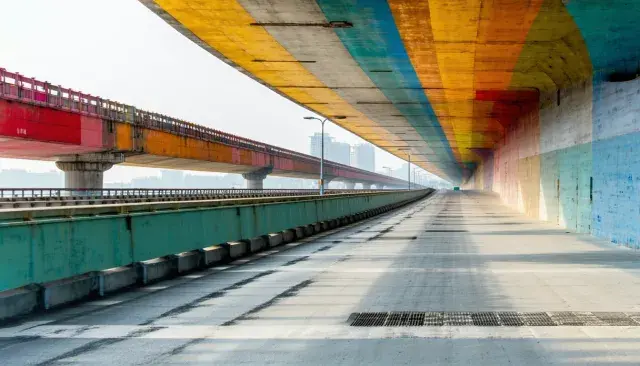

A Tk4,298 crore elevated expressway stretching from Lalkhan Bazar to Patenga was opened in August 2024 to ease one of Bangladesh's most chronic urban traffic crises - yet more than a year later, most city residents cannot use it. Incomplete ramps, stalled by bureaucratic friction between the Chattogram Development Authority, Bangladesh Railway, and Chattogram Wasa, have left the expressway operating at roughly one-fifth of its projected daily traffic volume. The project deadline has been pushed to December 2026, and whether that target holds depends on cooperation that, so far, has not arrived.
A Structure in Place, a City Still Stuck
The main carriageway carries freight and port-bound vehicles, but the residents of Chattogram's commercial and residential core - areas like GEC, Agrabad, and 2 No Gate - have seen little relief. Of the nine planned ramps, construction is active only at Fakirhat, CEPZ, and KEPZ. Four ramps are reported to be around 95% structurally complete but remain sealed because approach roads and toll booths have not been installed. The GEC ramp, which would connect Kohinoor City to Wasa Mor and serve as a critical entry point for central city commuters, is stalled at roughly 70% completion.
The shortfall in usage is stark. The project's feasibility study projected 39,388 vehicles per day for 2025. Actual daily traffic that year stood at 8,121 - about 20% of that figure. By 2026, usage has climbed past 10,000 daily, but the gap between expectation and reality reflects not a failure of demand but a failure to make the infrastructure accessible. Residents like Iqbal Ehsan, who commutes daily from 2 No Gate to Agrabad, continue to sit in surface-level congestion on roads that the expressway was built to relieve.
Two Bottlenecks, Two Agencies, One Outcome
The GEC ramp is blocked by a drinking water pipeline and regulator valve belonging to Chattogram Wasa. CDA paid approximately Tk3.5 crore for the relocation in June of last year. Ten months later, no visible progress has been recorded on the ground. Wasa's Managing Director has attributed the delay to the need to import equipment, a claim the project director has described as "extreme negligence." The contradiction is straightforward: payment was made, an obligation was established, and it has not been met.
The Agrabad ramp presents a different but equally paralysing obstacle. CDA has paid roughly Tk12 crore to Bangladesh Railway for 22 decimals of land in the Debar Par area, covering licence fees, security deposits, VAT, and taxes. An agreement was signed two months ago. The land has still not been handed over. Railway officials cite pending compensation for structures on the plot; CDA maintains that responsibility lies with the Railway to resolve. In the meantime, construction - which would require at least six months after land handover - has not begun. Even if the land were transferred immediately, completing the Agrabad ramp before December 2026 would require every subsequent step to proceed without interruption.
Planning Weaknesses and the Cost of Poor Coordination
The original design called for 15 ramps. That number was reduced to nine due to design complexities and constraints that, in a well-managed infrastructure project, are typically resolved before construction begins. Road transport experts have pointed out that land acquisition and utility relocation should precede construction commitments - not run parallel to them. When primary access routes depend on third-party agencies with separate mandates and timelines, delays are not exceptional; they are structurally inevitable unless contractual obligations carry enforceable consequences.
Engineer Subhash Barua, a road transport expert, has raised the question of legal recourse directly: if payment has been completed and land has not been transferred, the absence of legal action suggests a failure of administrative will as much as administrative capacity. Engineer Delowar Majumdar has noted that repeated design changes and alignment revisions point to planning weaknesses that may ultimately reduce the long-term effectiveness of the structure even after completion.
Urban elevated expressways, when functioning, can meaningfully reduce surface congestion and cut travel times in dense commercial corridors. The Chattogram expressway's core infrastructure exists and is structurally operational. The bottleneck is not engineering - it is institutional. Until Wasa completes pipeline relocation and the Railway transfers the Agrabad land, the city's largest recent infrastructure investment will continue to serve a narrow corridor of port traffic while the residents it was built to serve take longer routes through congested streets below.
